Proposals··8 min read
Best Proposal Template for Freelancers Who Freeze at a Blank Page
If writing proposals makes you stall, you do not need more clever wording. You need a simple structure you can reuse, adapt, and send without overthinking.
A blank proposal can feel heavier than it should. One new lead can represent next month’s income, a better portfolio piece, or a chance to work with the kind of client you have been trying to attract. That pressure is exactly why many freelancers overthink proposals, rewrite the opening ten times, or avoid sending anything until the moment has almost passed. The good news is that you do not need a fresh masterpiece for every inquiry. A strong proposal template for freelancers gives you a reliable structure, helps you respond faster, and lowers the chance that you forget something important.
The best freelance proposal template is not the fanciest one. It is the one you can actually use when you are busy, tired, or unsure how to price a project. Below is a practical format you can reuse across web design, writing, consulting, development, marketing, and other service work. Think of it as a working document, not a performance.
Why freelancers freeze when writing proposals
Proposal anxiety usually is not about writing skill. It is about stakes and uncertainty. You are trying to sound professional, prove you understand the work, set boundaries, explain pricing, and still come across like a real human. If the lead seems promising, every sentence can start to feel expensive.
This is also why vague proposals happen. When you are anxious, it is tempting to keep things broad so you do not scare the client away. But broad language often creates bigger problems later. As we covered in Scope creep usually starts with a vague proposal, missing detail at the proposal stage often turns into extra revisions, unclear expectations, and work you did not price for.
A reusable client proposal template helps because it turns the task from "write something persuasive from nothing" into "fill in the right sections clearly." That is a very different level of effort.
The simple proposal template you can reuse
Here is a practical structure that works well for most freelance services. You do not need every section to be long. In fact, shorter is often better if the details are clear.
- Project summary
- Goals or problem to solve
- Scope of work
- Deliverables
- Timeline and milestones
- Price and payment terms
- Assumptions or client responsibilities
- Next steps
A proposal does not need to impress with complexity. It needs to create clarity.
Here is what each part should do.
- Project summary - Briefly restate what the client needs and show you understood the conversation.
- Goals or problem to solve - Explain the result the project is meant to create, not just the tasks involved.
- Scope of work - List what is included so expectations are visible from the start.
- Deliverables - Name the tangible outputs the client will receive.
- Timeline and milestones - Show when work starts, key review points, and expected completion.
- Price and payment terms - State the project fee, deposit if any, and when invoices are due.
- Assumptions or client responsibilities - Note what you need from the client for the project to stay on track.
- Next steps - Make it obvious how they can approve and move forward.
This basic freelance proposal template is flexible enough for most projects. A copywriter might swap deliverables for "homepage copy, about page, and email sequence." A designer might include rounds of revisions and final file formats. A strategist might focus more on workshops, documentation, and decision points.
A fill-in proposal example for freelancers
If you freeze at wording, use this as a starting point and replace the placeholders.
Project summary: Based on our conversation, you are looking for help with [project type] to achieve [desired outcome]. This proposal outlines the scope, timeline, deliverables, and pricing for that work.
Goals: The goal of this project is to [increase leads, improve clarity, launch on time, reduce manual work, etc.]. Success will look like [specific outcome].
Scope of work: This project includes [task 1], [task 2], [task 3], and [task 4]. Work outside this scope can be quoted separately if needed.
Deliverables: You will receive [deliverable 1], [deliverable 2], and [deliverable 3].
Timeline: Work will begin on [date] once the proposal is approved and the initial payment is received. Estimated completion is [date], assuming feedback is provided within [timeframe].
Investment: The fee for this project is [price]. Payment terms: [example: 50 percent upfront, 50 percent on completion] or [net 14 from invoice date].
Client responsibilities: To keep the project moving, I will need [access, brand assets, content, feedback, approvals] by [timeframe].
Next steps: If this looks good, reply with approval and I will send the agreement and first invoice so we can schedule the start date.
This kind of client proposal template works because it reduces the pressure to sound original. You are not trying to entertain. You are helping a client make a decision.
How to adapt the template without rewriting everything
The easiest way to reuse proposal examples for freelancers is to separate fixed language from custom details. Keep one master template with standard wording for process, payment terms, revision limits, and next steps. Then customize only the parts that should change: the client’s goals, project scope, timeline, and pricing.
For example, a brand designer might keep the same paragraph explaining the process for discovery, concept presentation, revisions, and final file handoff. What changes each time is the number of deliverables, whether naming is included, the timeline, and the fee.
- Keep a short library of scope descriptions for your common services.
- Save 2 to 3 pricing structures you use often, such as fixed fee, phased pricing, or retainer.
- Reuse a standard section for payment terms and revision policy.
- Create versions for different project sizes, such as quick sprint, standard project, and premium package.
This is where a lightweight system helps. If your proposal process lives across old docs, email drafts, and notes in random places, every new lead feels harder than it should. How to Create a Freelance Workflow That Saves Time Every Week is a useful next read if your sales process feels more manual than necessary.
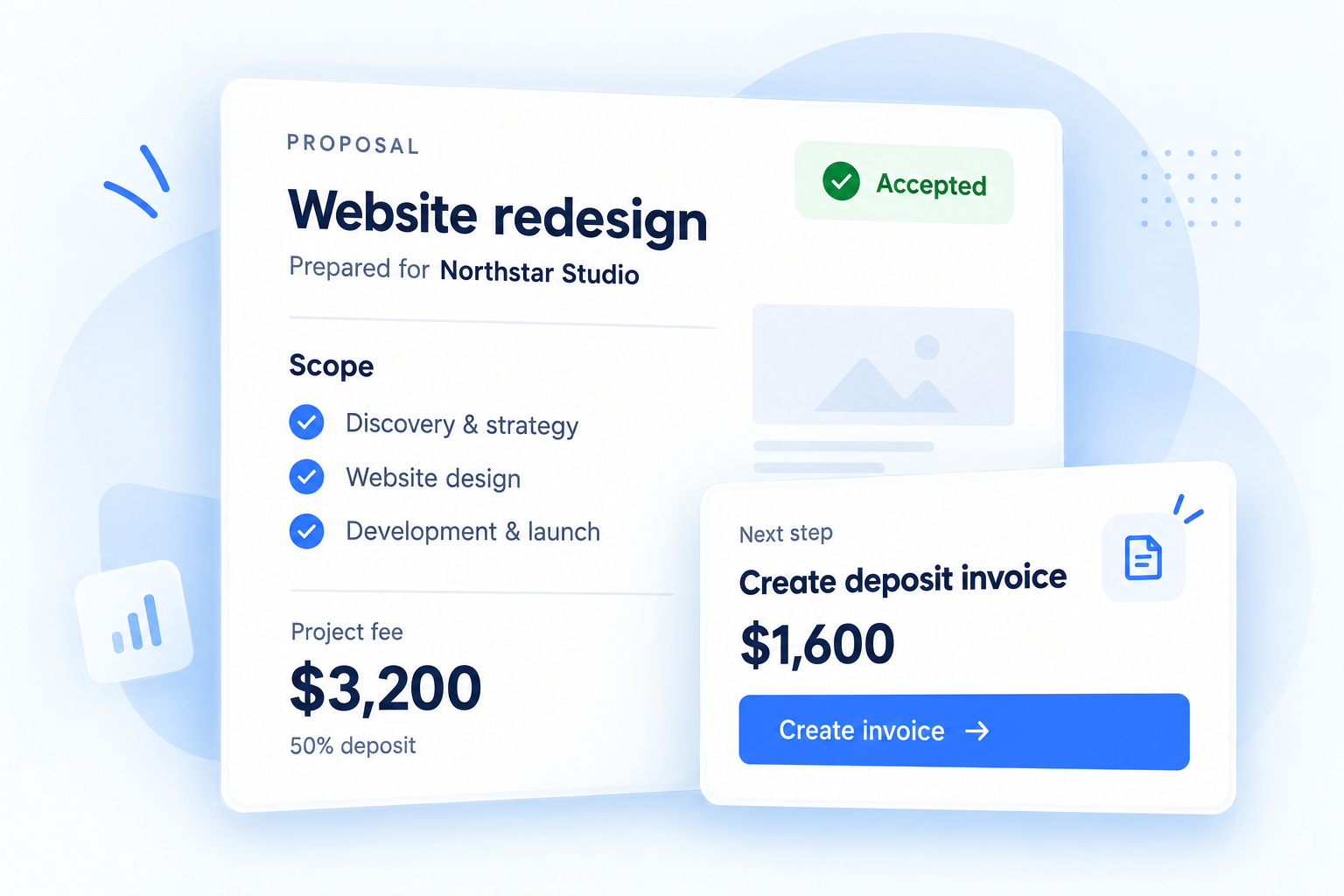
You can also keep proposals connected to your wider client process in one place, whether that is your own setup or a simple tool like Proposals. The point is not to add more software. It is to make sending the next proposal easier than sending the last one.
What to avoid in a freelance proposal
A good proposal says enough, but not too much. Many freelancers lose momentum by trying to cover every possibility in one giant document. Others go so minimal that the client has no idea what is actually included.
- Do not lead with your life story. Start with the client’s situation and the work.
- Do not use vague scope language like "design support as needed" unless you also define limits.
- Do not hide pricing or make the client ask for basic terms.
- Do not promise unrealistic timelines just to sound responsive.
- Do not skip payment terms, revision limits, or responsibilities.
- Do not underprice because you are afraid the proposal feels too simple.
That last point matters. A clear, concise proposal can still support a strong price. If pricing is the section where your confidence drops, Freelance Pricing Guide for People Who Hate Talking About Money can help you frame your numbers more calmly.
For payment language, it helps to align your proposal with invoicing habits that protect your cash flow. The U.S. Small Business Administration has a practical overview of business fundamentals at https://www.sba.gov, and if you work internationally, the Association of Independent Professionals and the Self-Employed offers solid freelancer resources at https://www.ipse.co.uk/.
What to do after you send the proposal
Many proposals do not get a response right away, even when the client is interested. That silence can trigger more anxiety than writing the proposal itself. Instead of assuming it is a no, build follow-up into your process from the beginning.
A simple approach works well: send the proposal, note the date, and set a reminder to follow up in 3 to 5 business days if you have not heard back. Keep the message brief. Ask if they have any questions or if there is anything they need from you to move forward. How to Follow Up With Clients Without Feeling Pushy covers this in more detail.
If the client approves, move quickly into the next step. Send the agreement, collect the deposit, and confirm the kickoff. The smoother this handoff is, the more professional the whole experience feels. If you invoice separately after approval, What to Include in an Invoice to Get Paid Faster is a good checklist.
Start with a template, then improve it through use
The best proposal template for freelancers is not perfect on day one. It gets better each time you use it. After every few projects, review what clients asked about, where scope got fuzzy, and which sections slowed you down. Then tighten the template. Over time, you will spend less energy writing and more energy choosing the right projects.
If you are staring at a blank page today, do not aim for brilliant. Aim for clear. Write a short project summary, define the scope, state the deliverables, set the timeline, include the price, and tell the client what happens next. That is enough to move the conversation forward, and often that is exactly what wins the work.
Put this workflow into practice
Rebban connects proposals, projects, time tracking, invoices, and payment reminders—so less work falls between tools.
Start free trial