Projects··8 min read
How to Organize Freelance Projects Without a Complicated System
You do not need a maze of tools to stay on top of client work. A simple project organization system can be enough to keep deadlines, files, and communication clear.
A lot of freelancers try to solve project chaos by adding more tools. Another dashboard, another board, another automation, another color-coded system. It feels productive for a week, then it becomes one more thing to maintain. If your real goal is to organize freelance projects so nothing important slips, you probably need less than you think. A simple system can handle most client work if it covers three things well: what needs to be delivered, when it is due, and where communication lives.
Good freelance project management is not about recreating an agency operations team for a business of one. It is about building enough structure that you can trust your week. When a client asks for an update, you should know the status quickly. When you sit down to work, you should know the next task. When a deadline is near, you should not have to hunt through emails, notes, and chat threads to figure out what was agreed.
Start with the minimum structure every project needs
Project organization for freelancers usually falls apart because information is spread across too many places. Before you add any system, decide what the bare minimum for every project will be. In most cases, that means one project record with five fields: client name, scope, deadline, current status, and next action.
That is enough to manage a website copy project, a branding package, a monthly retainer, or a video editing job. You do not need twenty custom tags to know whether something is moving. You need a reliable home for the essentials.
- Client name and project name
- What is included in the scope
- Key due dates and milestones
- Current status such as not started, in progress, waiting on client, or complete
- One clear next action
That last point matters more than most freelancers realize. The reason projects feel messy is often not because there are too many tasks. It is because there is no defined next step. If a project says only "website redesign" or "Q3 content," it creates mental friction every time you look at it. If it says "waiting on homepage copy from client" or "send first draft by Thursday," you immediately know what is happening.
A simple system works when every project has one obvious next step.
Keep deliverables, deadlines, and communication in one place
Most missed details do not happen because freelancers are careless. They happen because details are fragmented. The brief is in email, revisions are in Slack, the due date is in your calendar, your notes are in a document, and the invoice is somewhere else. Even if each tool is good on its own, the overall system creates gaps.
A simple project management system works best when each client project has one main home. That home does not need to be complex. It just needs to hold the latest scope, files or file links, key messages, task list, and due dates. If your work is currently split across five apps, read When client work lives in five apps, something always slips. The problem is often not discipline. It is fragmentation.
For example, imagine you are a freelance designer with three active clients. One needs a logo revision, one is waiting on feedback, and one has a final invoice due after delivery. If each project has a single place where status and next steps live, your morning review takes ten minutes. If those details are scattered, you lose time piecing the day together before you even start working.
This is also where boundaries become easier. If the agreed deliverables are visible, it is easier to spot when a request falls outside scope. That conversation is much harder if the original agreement is buried in old messages. How to Prevent Scope Creep Before a Project Starts is helpful if this is a recurring issue.
Use a short status system you can review in minutes
You do not need a detailed production pipeline unless your work truly requires it. Many freelancers can manage projects with just four statuses:
- Not started
- In progress
- Waiting on client
- Complete
That is enough to create visibility without overcomplicating your workflow. The point of status is not to track every micro-step. It is to reduce uncertainty. At a glance, you should be able to answer: what needs attention today, what is blocked, and what is done.
Freelance project management gets much easier when you build a quick review habit around those statuses. Once or twice a week, scan all active projects and update the next action for each one. If a client owes feedback, mark it clearly. If a deadline moved, change it immediately. If a project is done, close it instead of letting it clutter your list.
This kind of review is simple, but it prevents the quiet drift that leads to missed follow-ups and last-minute stress. If a project is stuck in waiting mode for too long, you can use a calm reminder process like the one in How to Follow Up With Clients Without Feeling Pushy.
Separate project tasks from your daily to-do list
One common mistake in project organization for freelancers is treating every project task as if it belongs on today's task list. That creates an overwhelming list of fifty items, most of which are not relevant right now. The result is a constant sense of being behind.
Instead, keep the full project task list inside the project, then pull only the current next actions into your daily plan. For example, your branding project may include discovery, moodboards, first concepts, revisions, and final files. But today you only need to do one thing: prepare the concept presentation.
This small distinction protects your focus. It also makes planning more honest. You stop pretending you will complete an entire project phase in one afternoon, and start choosing concrete actions you can actually finish.
If you want a broader structure around this habit, How to Create a Freelance Workflow That Saves Time Every Week pairs well with a simple project setup.
- Keep project-level tasks inside the project record
- Move only active next steps into today's list
- Review upcoming deadlines before planning your week
- Close finished tasks quickly so your list stays clean
Build your system around handoffs and waiting points
The most fragile moments in freelance projects are usually handoffs: sending a proposal, waiting for approval, delivering a draft, requesting feedback, or invoicing at the end. That is where projects stall or details get lost. A practical simple project management system pays extra attention to those transitions.
Ask yourself where your projects most often slow down. Maybe clients take a week to send source files. Maybe you forget to invoice after final delivery. Maybe revision requests come through multiple channels and turn into confusion. Those are not personal failures. They are signs that your process needs a clearer checkpoint.
For example, after you send a draft, your system should immediately tell you two things: when to follow up if you hear nothing, and what happens next once feedback arrives. After final delivery, it should point straight to the invoice. If payment admin often lingers, What to Include in an Invoice to Get Paid Faster is worth bookmarking.
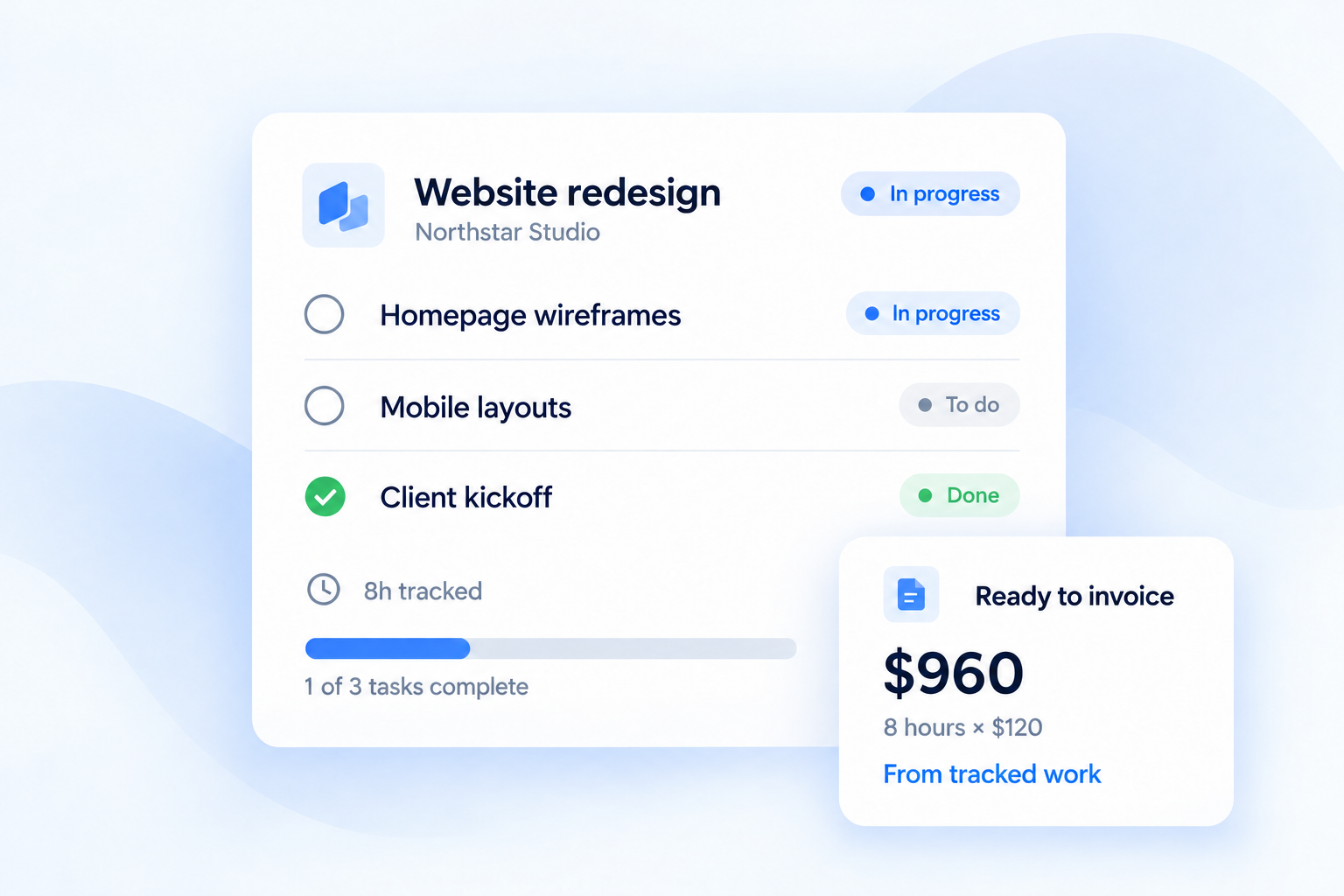
If you use software for this, simpler is often better. A lightweight project view, a clean proposal process, time tracking when needed, and invoicing in the same flow can remove a surprising amount of friction. That is part of the appeal of keeping proposals, projects, and invoices connected without building a giant operating system for yourself.
Choose consistency over complexity
The best system is the one you will still use during a busy month. That usually means fewer steps, fewer places to check, and less maintenance. A color-coded board with custom automations might look impressive, but if updating it feels like admin, you will stop trusting it. Once that happens, your system becomes decoration.
A consistent simple system might look almost boring. That is a good sign. Boring systems are easier to repeat. They make your freelance project management more dependable because the rules stay the same from project to project.
A practical weekly rhythm can be enough:
- Monday: review active projects and deadlines
- Midweek: update statuses and send any needed follow-ups
- Friday: close completed tasks, note open loops, and prepare next week's priorities
If you want external proof that simpler systems can outperform complicated ones, the core time management guidance from sources like the Harvard Business Review often comes back to clarity, prioritization, and reducing cognitive overload, not adding more process. And if you are handling records, taxes, or business admin in the US, the U.S. Small Business Administration has useful guidance on keeping documentation organized.
To organize freelance projects well, you do not need to become a project manager full time. You need one trustworthy place for each project, a few clear statuses, visible deadlines, and a habit of updating the next action. That is enough to keep client work moving without carrying the weight of a complicated system. Start smaller than you think. If your setup helps you see what matters, what is waiting, and what needs to happen next, it is already doing its job.
Put this workflow into practice
Rebban connects proposals, projects, time tracking, invoices, and payment reminders—so less work falls between tools.
Start free trial